

The complete guide
How To Choose A Silk Bonnet That Actually Works
The problem nobody notices until they stop
Hair damage is sneaky. You do not see it happen. You blow dry carefully, you use the good conditioner, you keep heat tools to a minimum, and then you spend a third of your life rubbing your head against a cotton pillowcase.
Cotton is a thirsty, textured fibre. Under a microscope the surface is nothing like smooth. Every time you turn over, hair catches on it and drags. Over one night that barely matters. Over three hundred nights it shows up as frizz at the crown, ends that look rougher than they should, and curls that have lost their shape by breakfast.
A silk bonnet solves this by changing the surface. Instead of hair against cotton, you get hair against silk, which slides. That is the whole mechanism. No magic, no claims about growth or thickness, just less friction between your hair and everything it touches overnight.
What silk does and does not do
Worth being plain here. Silk is smooth, and hair moves across it with less resistance than across cotton. That is a physical property of the fibre, and it is the reason silk bedding and silk caps exist.
Silk is also a protein fibre that does not wick moisture out of hair the way absorbent cottons do. If you apply a leave-in conditioner or an oil before bed, more of it tends to stay where you put it rather than soaking into your pillowcase.
What silk will not do is change your hair itself. It does not treat your scalp, it does not alter texture, it will not fix breakage that has already happened. It reduces one source of mechanical wear. For a lot of people that is enough to notice within a fortnight, especially if you have curls or long hair.
Momme, grade and why the numbers appear
Two numbers come up constantly when shopping for silk, and both are on this bonnet.
Momme is the weight measure. It tells you how dense the fabric is. Low momme silk, somewhere in the low teens, feels thin and tends to wear out faster. Very high momme, up past 25, feels luxurious but can be heavier than you want on your head. Twenty-two momme sits in the sweet spot that most silk bedding settles on. It has enough body to drape properly and hold up to repeated washing, without being warm or stiff.
Grade refers to the raw silk filament. The scale runs up to 6A, which is what this cap uses. Higher grades come from longer, more even filaments, which produce a smoother and stronger finished fabric with fewer slubs. You do not need to memorise the system, just know that 6A at 22 momme is a solid combination rather than a bargain-bin one.
The double layer question
This is the detail that separates bonnets that work from bonnets that look like they work.
A surprising number of caps sold as silk have a silk outer and a synthetic inner. The shell photographs beautifully. The lining, which is the only part your hair ever touches, is polyester. You are paying for silk and sleeping on plastic.
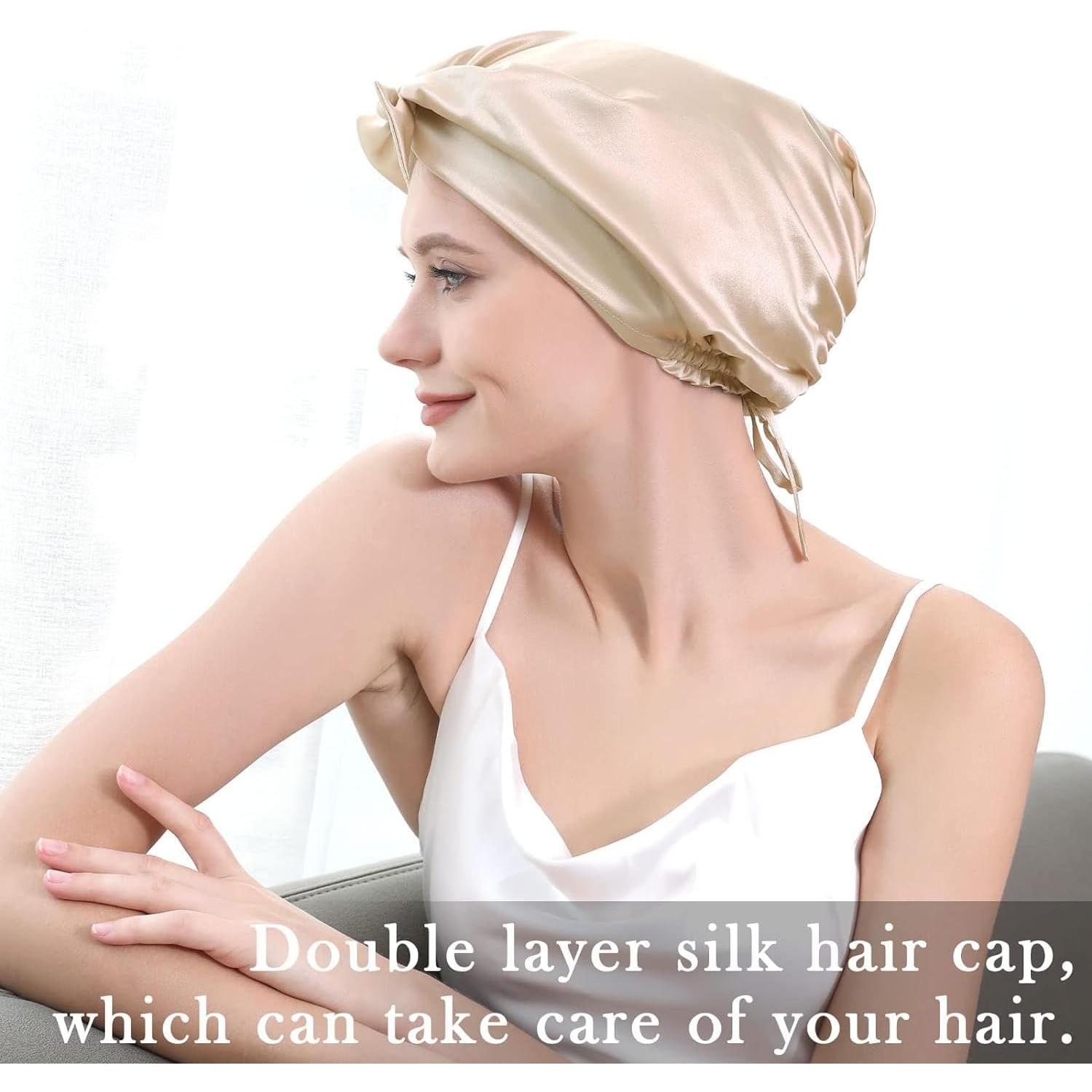
A double layer silk bonnet puts the same silk on both faces. That means the inside is as smooth as the outside, and it means you can wear the cap either way round. It also sits better on the head, because two layers of the same fabric balance against each other rather than one slipping over the other through the night.
If you only check one thing when comparing bonnets, check what the lining is made of.
Fit, and why elastic beats ties
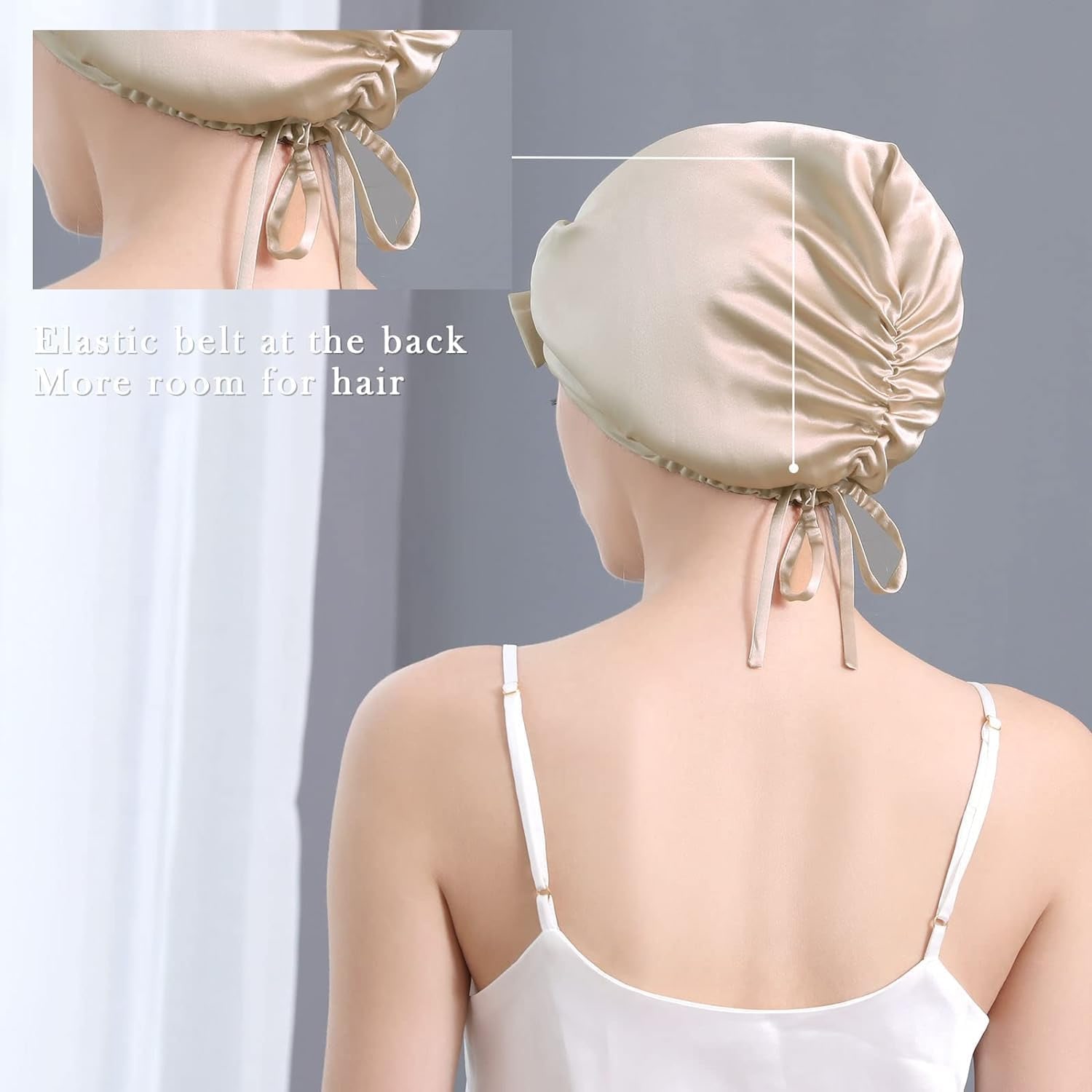
This cap is one size with a covered elastic band at the back. Exact measurements are not given in the supplier record, so if your head size sits well outside average it is worth measuring your circumference first.
For most people, elastic is the better closure. Ties need adjusting in the dark and tend to loosen as you move. Clips dig in. A band does the work by itself and you can pull it a touch lower at the nape if you want it more secure.
The crown has room to gather hair into. Long hair should be loosely coiled, not stuffed. Braids go up and in. Short hair needs nothing special, since the band holds the cap without relying on volume underneath. A silk sleeping cap for women with fine, short hair works just as well as one on thick coils, which is why one size covers so many people.
Who gets the most out of one
Curly and coily hair types tend to feel the difference fastest. Friction is what turns a defined curl into a flat, fuzzy patch by morning, and removing it means a wash-and-go stretches an extra day or two.
Long hair is next. More length means more surface area dragging across the pillow, and more opportunity for tangles to set in overnight.
Anyone using overnight treatments benefits too. Oils, masks and leave-ins work better on your head than on your bedding.
And if you have recently had a blow-out, a set, or any style you want to preserve, a cap is the simplest way to wake up with it still roughly intact.
Looking after it
Silk responds well to being left alone and badly to being treated like a tea towel.
Wash in cool water with a detergent made for delicates. Hand washing is kindest, and it only takes a couple of minutes. If you use the machine, put the bonnet in a mesh bag on a cold gentle cycle and keep it away from zips, hooks and anything heavy.
Skip the bleach. Skip the fabric softener. Skip the dryer entirely, because heat is hard on both the silk and the elastic band.
Press the water out gently rather than wringing, then hang it somewhere shaded and airy. Direct sun fades dyed silk over time, and champagne is a colour where fading shows.
If it creases, a cool iron with a cloth over the fabric sorts it out in seconds. Do not steam it at high heat.
Washed this way, every week or two depending on your routine, a 22 momme cap holds its finish for a long stretch.
Bonnet or pillowcase
People ask which to buy. The honest answer is that they do different jobs.
A silk pillowcase protects your face as well as your hair and covers the whole sleeping surface, so it works even if you are the sort of person who flings a cap off at 2am. A bonnet keeps hair contained in one place, travels easily, and works no matter whose bed you are in.
If your main concern is curl definition or keeping product on your hair, the bonnet is the more targeted tool. If your main concern is sleep creases on your face, go for the pillowcase. A lot of people end up with both, and they work perfectly happily together.
A note on colour
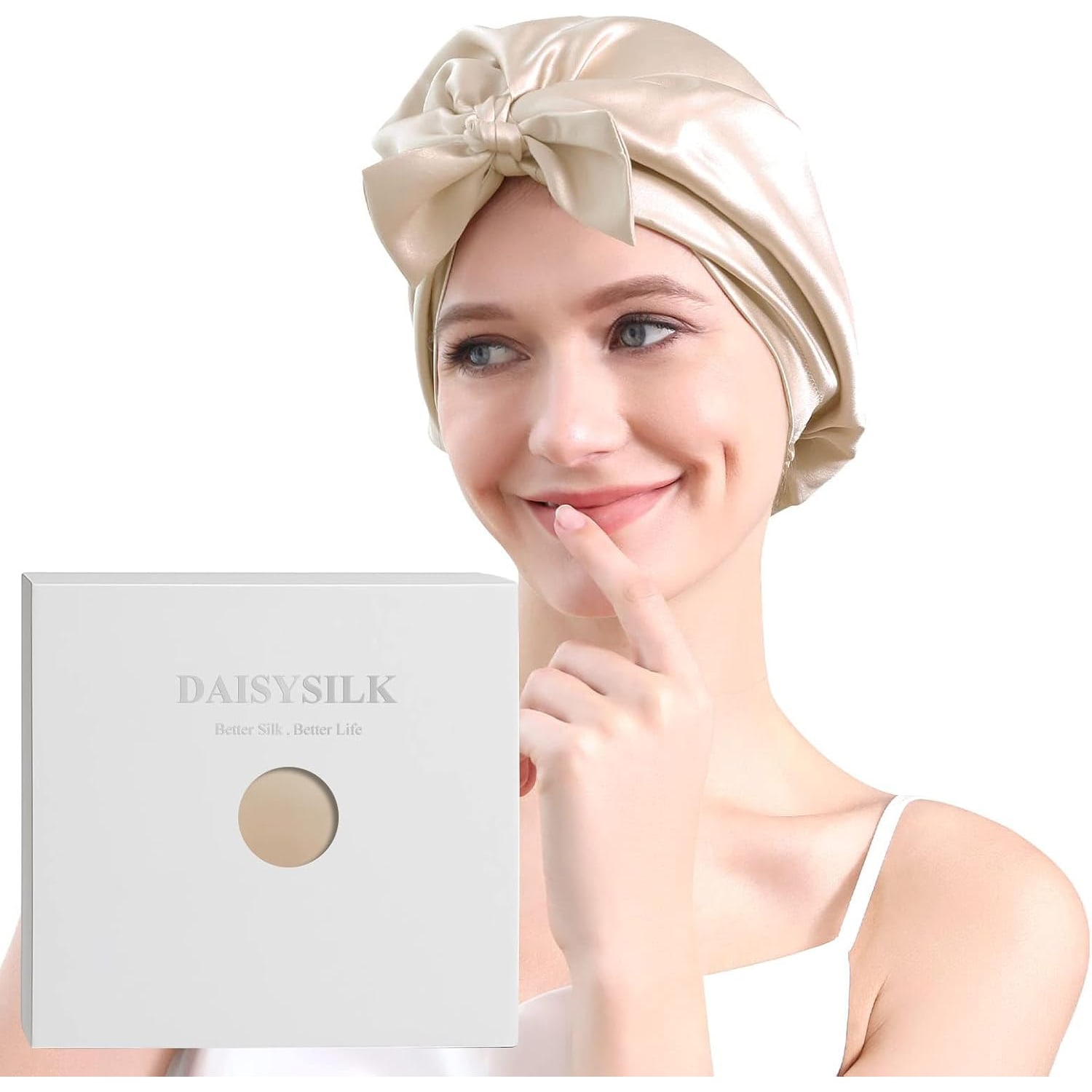
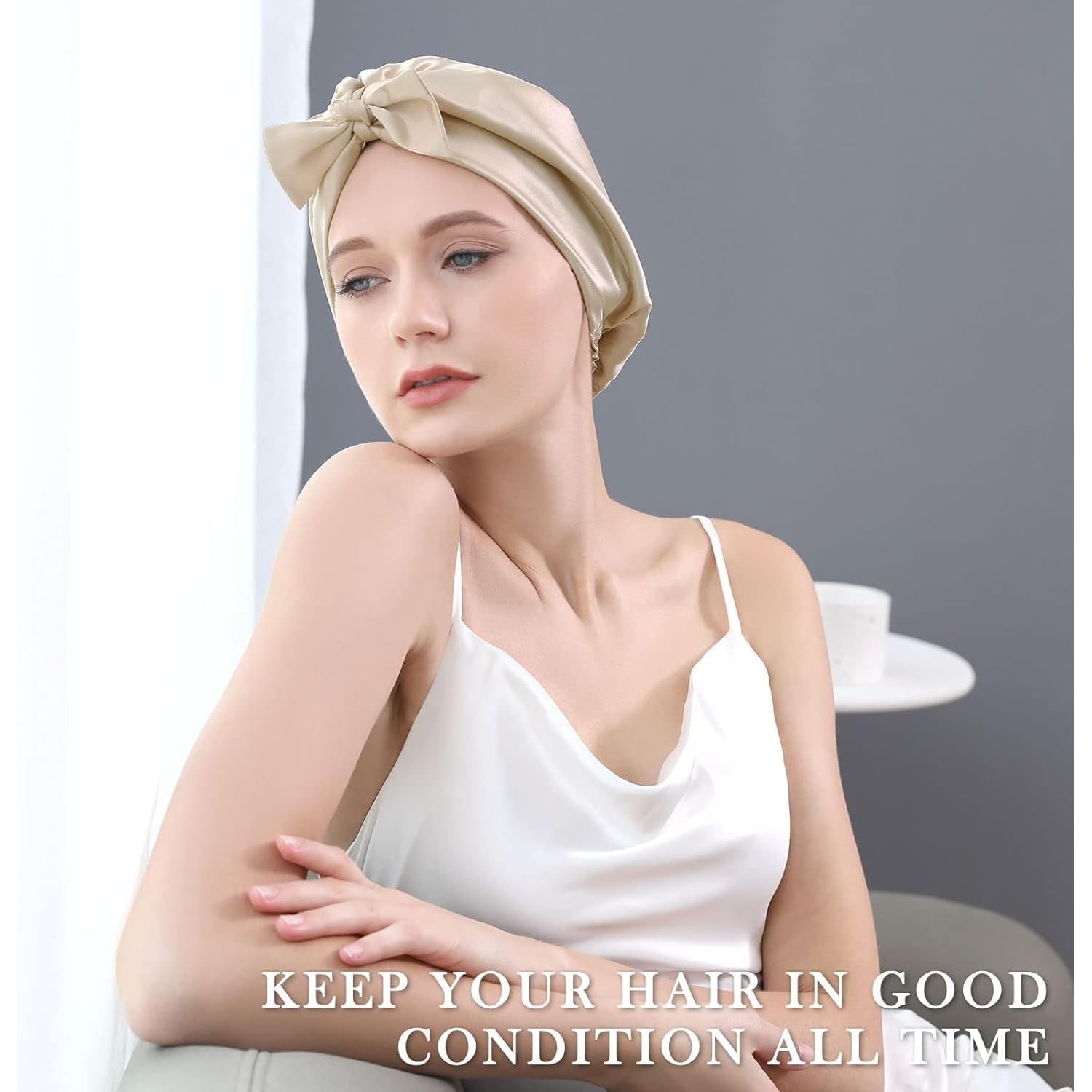
Champagne is a warm, pale neutral. In daylight it leans gold, under a lamp it reads closer to ivory. It is a calmer choice than white, which shows every mark, and than black, which shows every stray hair. If you already have silk pillowcases or an eye mask in a neutral tone, it will sit alongside them without clashing.
Screens render pale golds differently, so treat the photographs as a guide rather than an exact match.
The short version
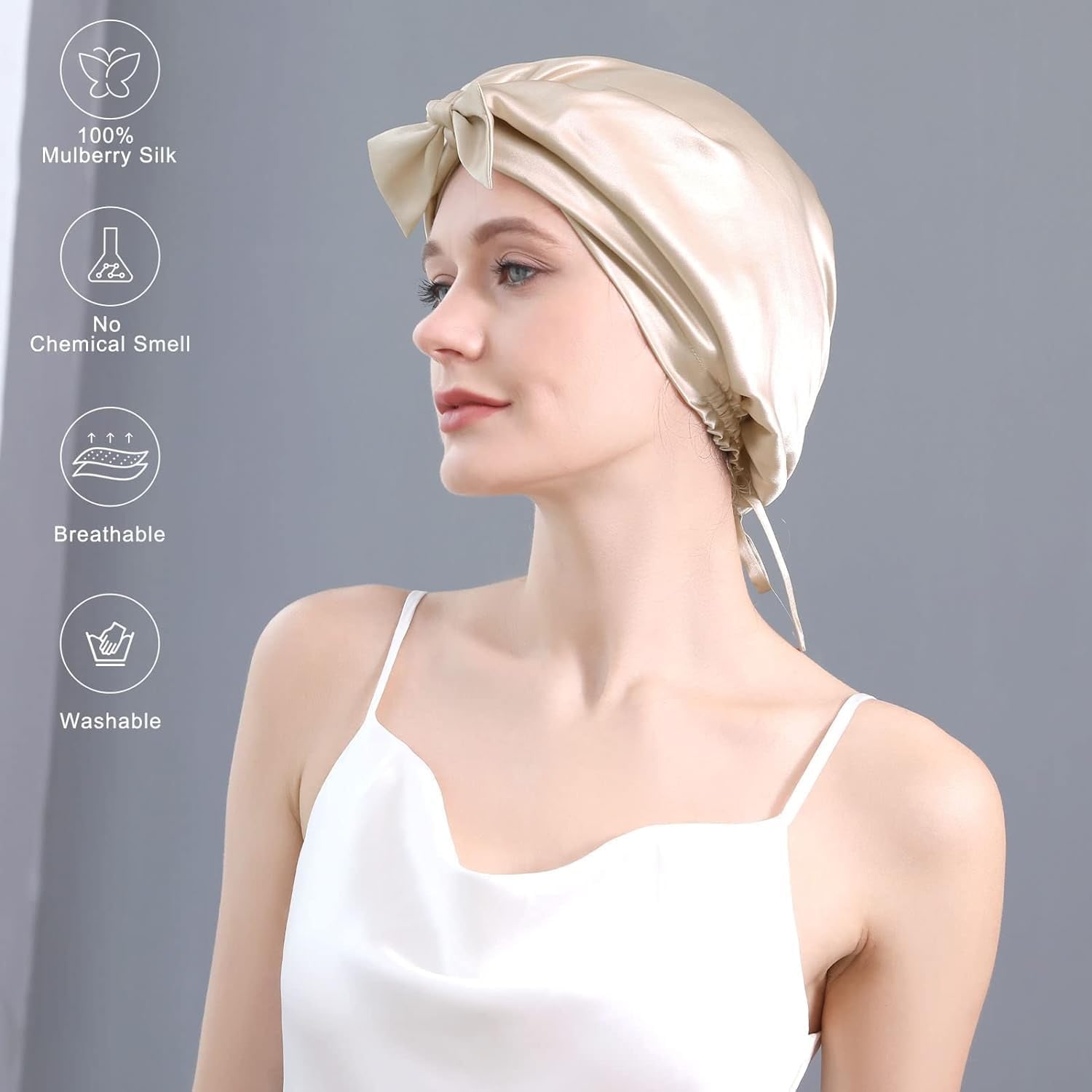
Twenty-two momme, 6A mulberry silk, double layered so the inside is silk too, one size, elastic band at the back. That covers what matters.
A silk bonnet reduces friction between your hair and your bedding. It will not transform your hair, but it will stop one steady source of wear, and for curls, long hair and anyone using overnight treatments, that shows up pretty quickly.
Wash it cool, dry it in the shade, keep it away from the dryer. That is the entire maintenance routine.