
The complete guide
How To Choose Silk Scrunchies That Actually Suit Your Hair
The problem with ordinary hair ties
Most of us learned to tie our hair back with whatever was nearest. A thin elastic from a chemist packet. A rubber band off the broccoli. A fabric tie from the supermarket that was fine for a week and then went slack.
They all do the basic job. They also all share the same flaw. The hold comes from a narrow strip pressing hard against one small section of hair. That concentrated pressure is what gives you the dent, the sore patch behind your ear and the little fuzz of broken ends where the tie sat all day.
A large silk scrunchie solves that by changing the shape of the problem. Instead of a thin line of pressure, you get a wide band of gathered fabric spreading the hold across a much bigger area. Less force in any one spot. Less of a mark when you take it out.
What a silk scrunchie actually is
Under the fabric, a scrunchie is just an elastic loop. The difference is everything wrapped around it.
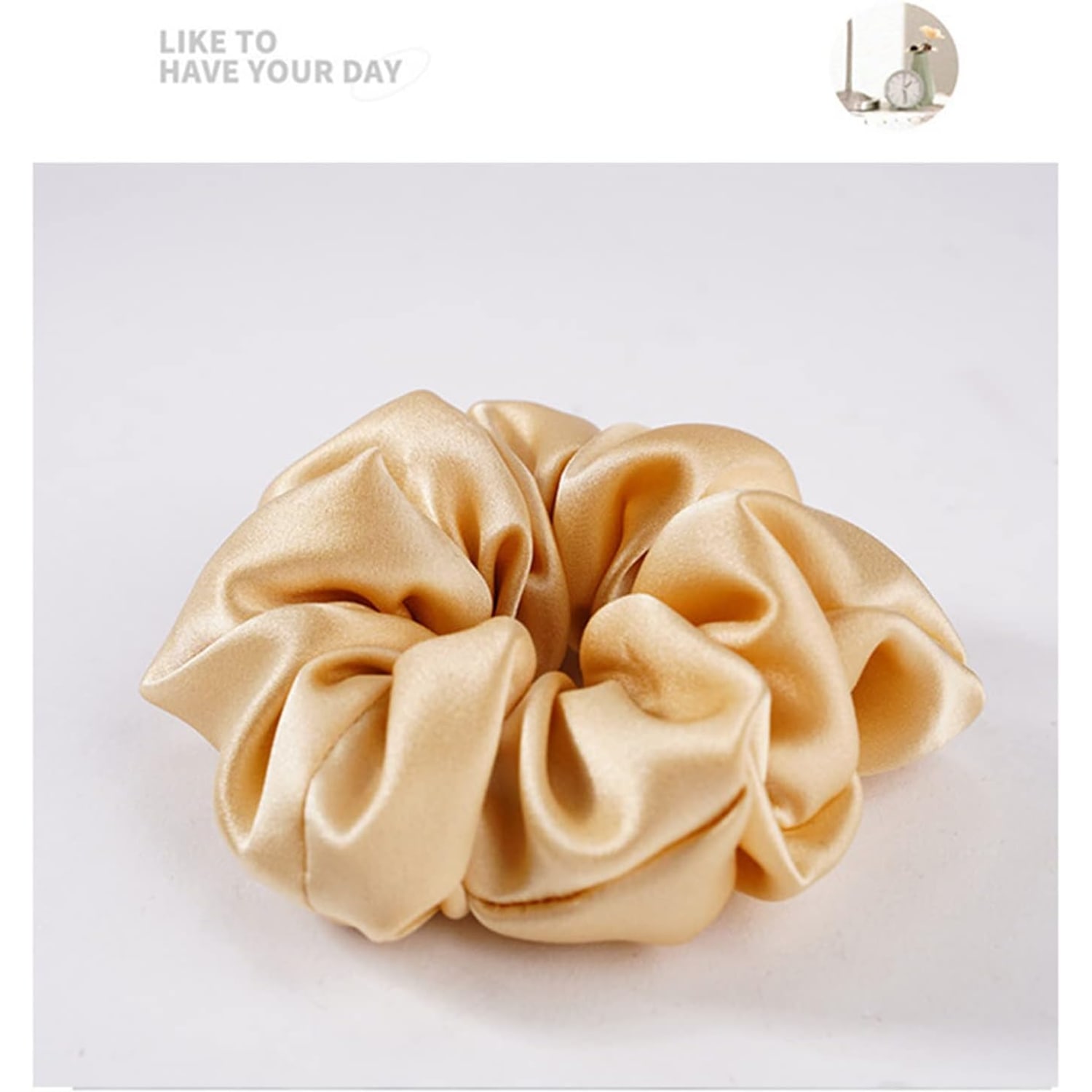
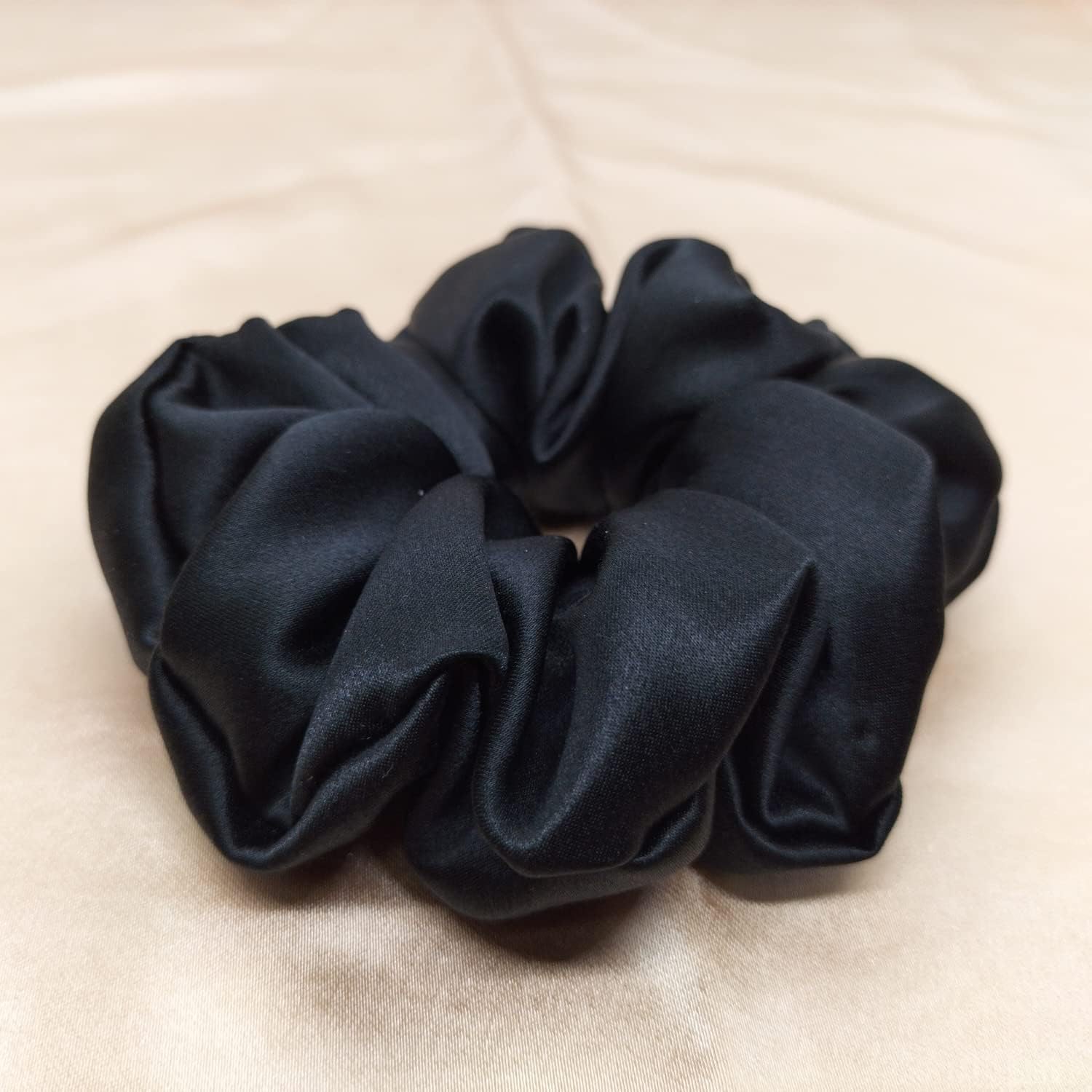
A sewn tube of silk is gathered along the elastic so the fabric bunches up. That bunching is what creates the soft, full look, and it is also what gives you the wider contact area. When you wrap the scrunchie around a ponytail, the gathers compress and grip, but they grip with cloth rather than rubber.
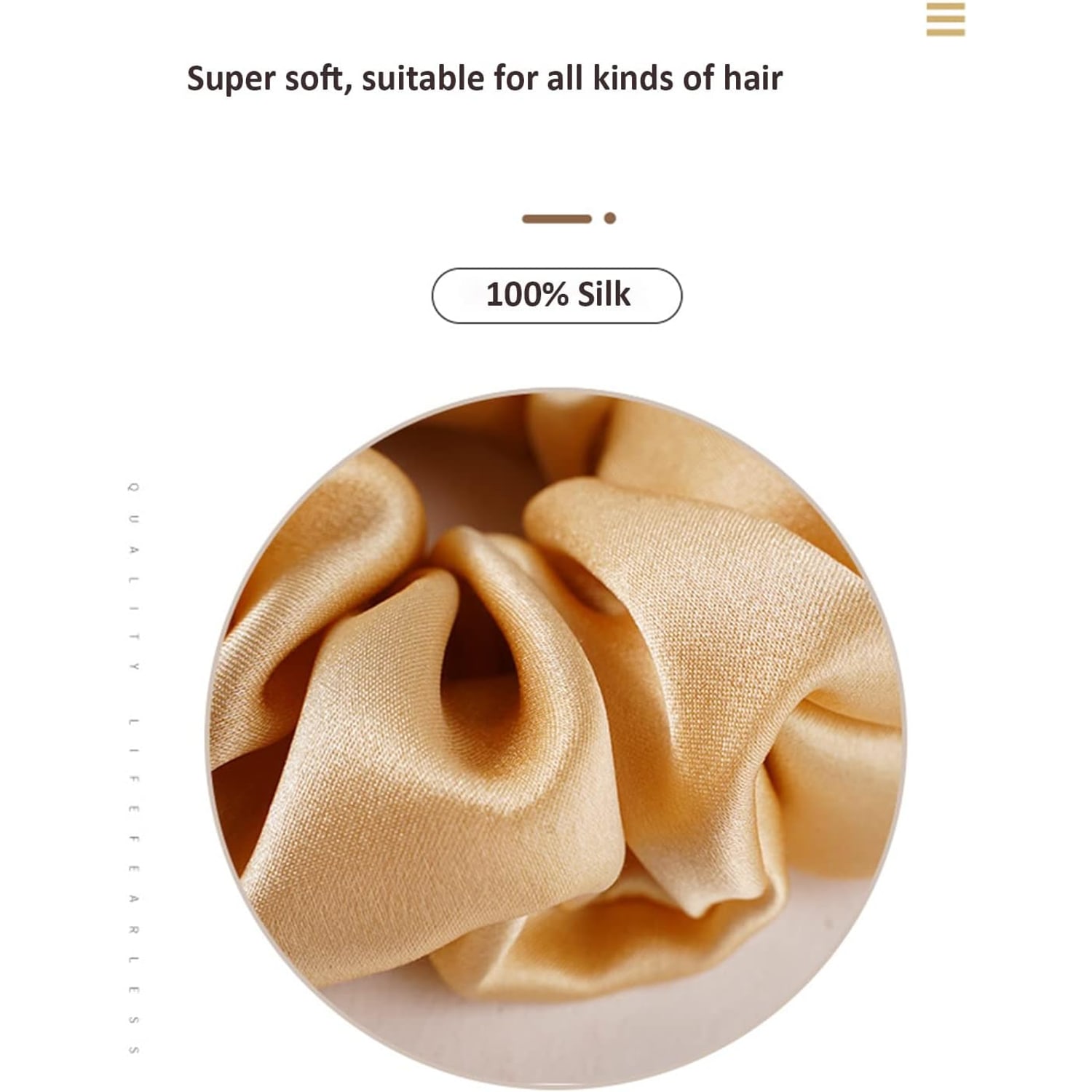
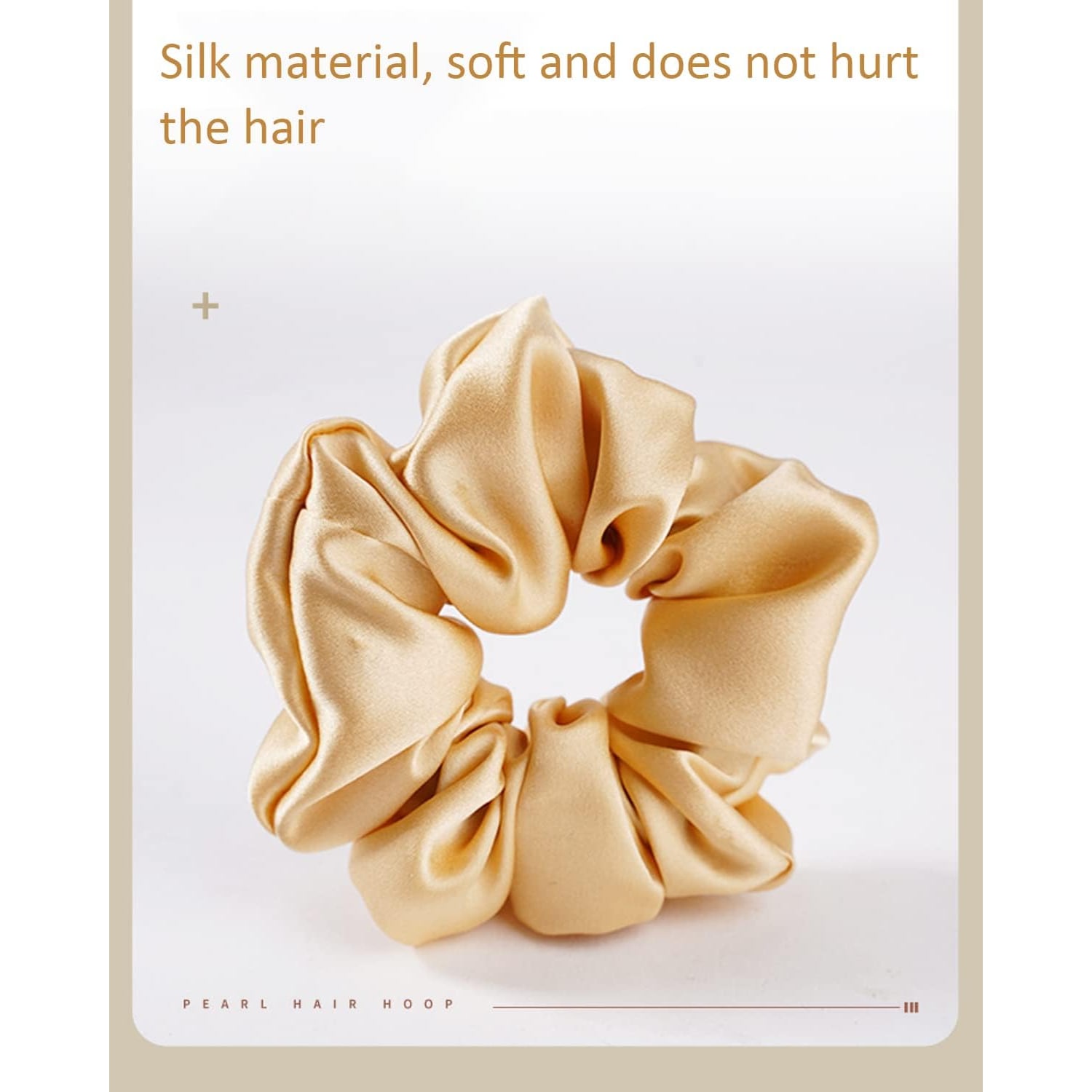
Silk matters here because of its surface. It is a smooth fibre, so hair slides across it with less friction than it does across cotton, terry towelling or a bare elastic. You feel this most when you take the tie out. A silk scrunchie tends to ease off rather than drag.
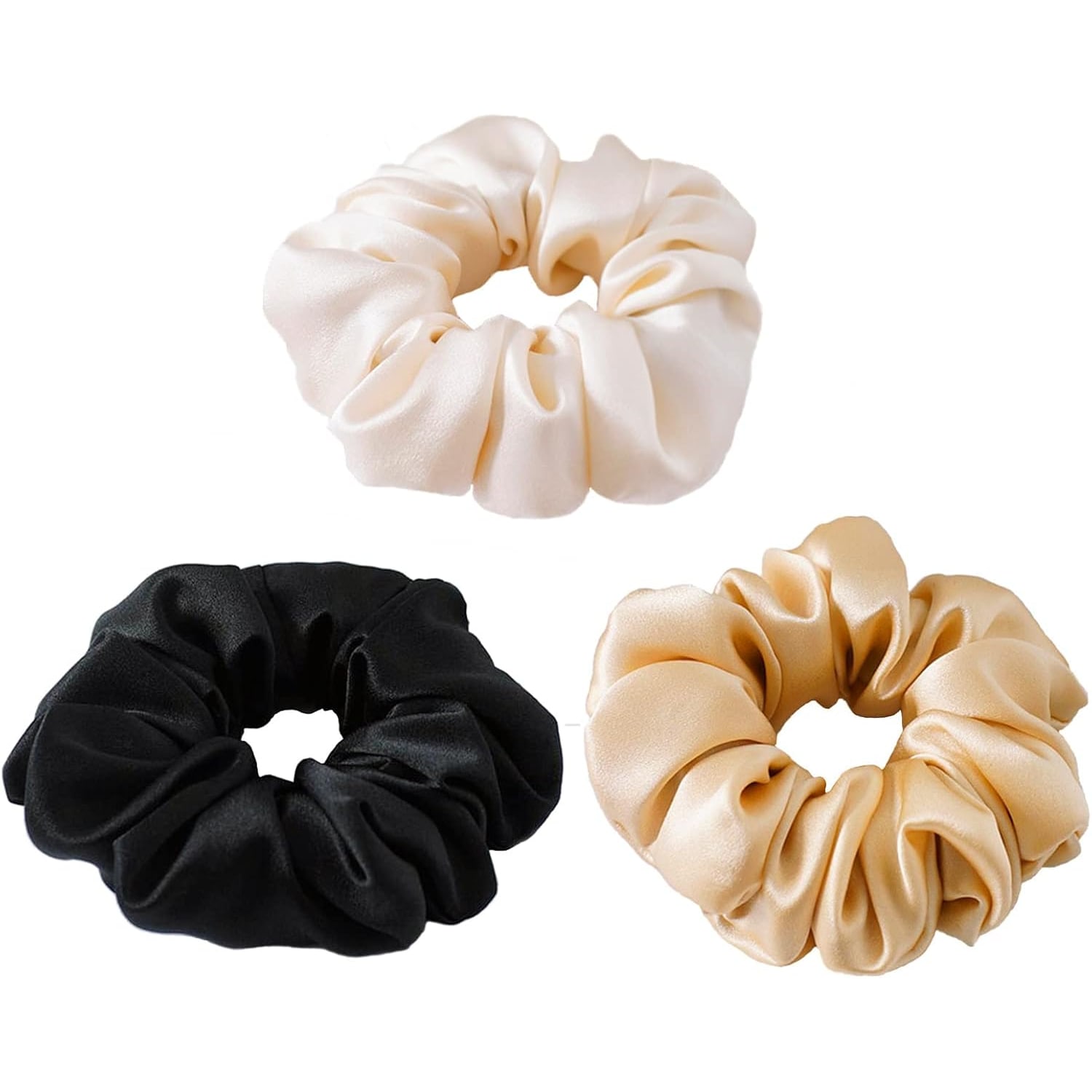
This set is listed as silk, in a large size, with a stretch range of roughly 10 cm to 22 cm around. The momme weight and weave are not specified in this record, so we will not guess at them.
Who these suit
The honest answer is most people, but some will notice the difference more than others.
If you have thick or curly hair, the large size is the main draw. A standard small scrunchie has to be stretched near its limit to get around a thick ponytail, and a stretched-out elastic is both uncomfortable and short-lived. A large one takes that bulk in its stride, usually with a single loop and a half twist.
If you have fine hair, the appeal is comfort rather than capacity. You will need a few wraps to feel secure, and the trade-off is that the fabric never digs in the way a thin elastic does. Plenty of people with fine hair prefer silk hair ties for exactly this reason.
If you mostly tie your hair up for sleep, a large scrunchie is a good shape to work with. A loose bun held high and soft keeps hair off your face and does not create a hard lump to lie on.
If you want something that looks a bit more finished than a black elastic on your wrist, the champagne one in this set does that quietly. Silk has a soft shine that reads as considered without being flashy.
Choosing a size
Scrunchies come in roughly three sizes, and the right one depends on hair volume more than hair length.
Small ones are tidy and discreet. They work for fine hair, braids and tight styles, but they struggle with bulk.
Medium is the all-rounder. It handles most ponytails and does not look oversized.
Large, which is what you have here, is for volume and for look. If your ponytail is thick, if your curls take up space, or if you simply like the fuller look of a big scrunchie sitting at the base of your hair, go large. The stretch range to 22 cm means it will also happily hold a smaller ponytail with extra wraps.
A quick test. Wrap your hand around your dry, gathered ponytail and look at how much space your fingers make. If the circle is close to or wider than a drink can, a large scrunchie is the sensible pick.
Picking colours
You get three here, so the pressure is off, but it is worth knowing what each one does.
Black is the workhorse. It vanishes into dark hair, it does not fight with anything you wear, and it is the one to grab for the gym or a long day at a desk.
Apricot is warm and soft. It shows up nicely against blonde, light brown and grey hair, and it looks intentional rather than functional.
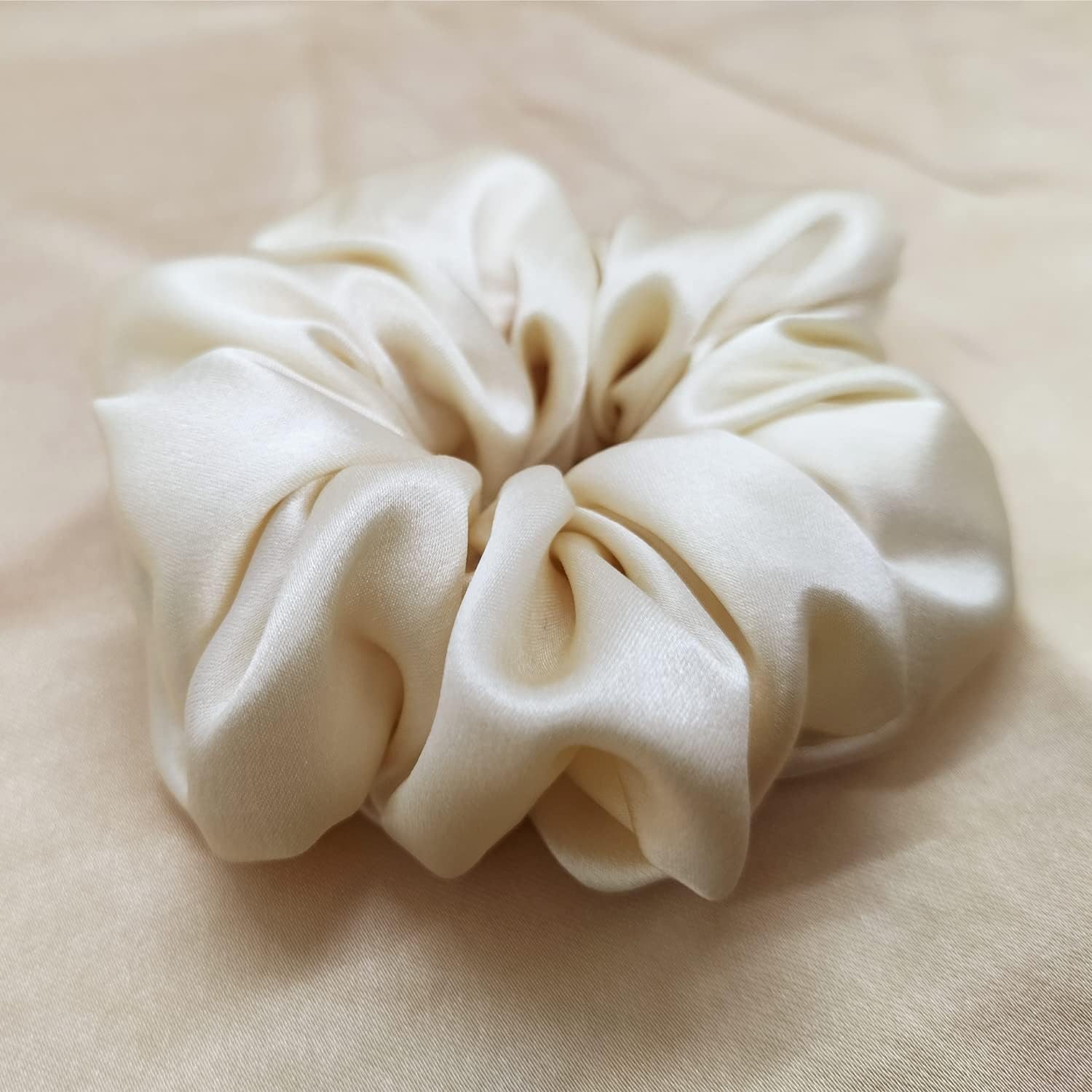
Champagne is the pale neutral. It has a bit of sheen, which makes it the one for a dinner or an event where you still want your hair up but want it to look considered.
Spread them out. One in the handbag, one on the bedside table, one in the gym bag. That way you always have one to hand, and no single scrunchie takes all the wear.
Getting the hold right
A scrunchie behaves differently from a thin elastic, and a lot of first-time frustration comes from treating them the same way.
Gather your hair, hold it in one hand, then slide the scrunchie on rather than stretching and snapping it. Each wrap adds grip, so stop when it feels secure rather than when it feels tight. Overtightening is the main cause of marks and discomfort, and it does not actually make the hold last longer.
For thick hair, one loop with a half twist usually does it. For fine hair, two or three wraps. For a bun, loop it once around the twisted hair, then pull a section of hair through on the final wrap.
To take it out, ease the loop open with two fingers and lift it off. Pulling it straight down the length of your hair is what causes snagging, no matter what the tie is made from.
Looking after them
Silk does not demand much, but it does ask for a little care.
Wash by hand in cool water with a detergent made for delicates. Swirl rather than scrub, and skip the soaking. Rinse until the water runs clear, then press the scrunchie between a folded towel to take the water out. Do not wring it.
Reshape the loop while it is damp and lay it flat to dry, somewhere out of direct sun. Heat and strong sunlight are both hard on silk and on elastic, so skip the dryer and the radiator.
Wash the black one on its own the first time, as you would with any dark dyed fabric. After that the three can share a basin.
Store them flat or loosely in a drawer. The one thing to avoid is leaving a scrunchie stretched over a bottle, a jar or a door handle for weeks at a time. That slowly tires the elastic and you lose the snap.
Wash every week or two with normal wear, and more often if you wear one to the gym or use a lot of styling product. Rotating through all three keeps any one of them from doing all the work.
When a scrunchie is not the answer
It is worth being straight about this. A scrunchie is a soft, forgiving hold. If you need a ponytail that will not shift through a netball game or a long run, a tight sports elastic will hold firmer, and you accept the crease as the price.
Scrunchies are at their best for everyday wear, for working at a desk, for sleep, for the school run and for days when your hair goes up and down a few times. That is a lot of hours, which is why most people end up owning several.
The short version
A large silk scrunchie spreads the hold across a wide band of smooth fabric instead of a thin line of rubber. That is more comfortable, kinder to the hair where it sits, and it leaves a softer mark when you take it out.
This set gives you three in black, apricot and champagne, with a stretch range of roughly 10 cm to 22 cm, so it covers fine hair with a few wraps and thick hair with one. Hand wash in cool water, dry flat, store loose, and they will keep their look.
If you have been using the same stretched-out elastic for a year, this is an easy upgrade and an easier gift.